Home / Field guide

Free area guide · Big Bay & the Blouberg coast

Glass, salt and the southeaster.

The Big Bay window field guide

On this coast the view and the setting sun sit on the very same wall of glass — and a wind that hosts the Red Bull King of the Air is working on your hardware the whole time. Here is what the Cape light actually does to a Big Bay house, elevation by elevation, with the trade-offs written down rather than glossed over.

About 9 minutes to read Written August 2026 Free — no email needed to read it Sources at the foot
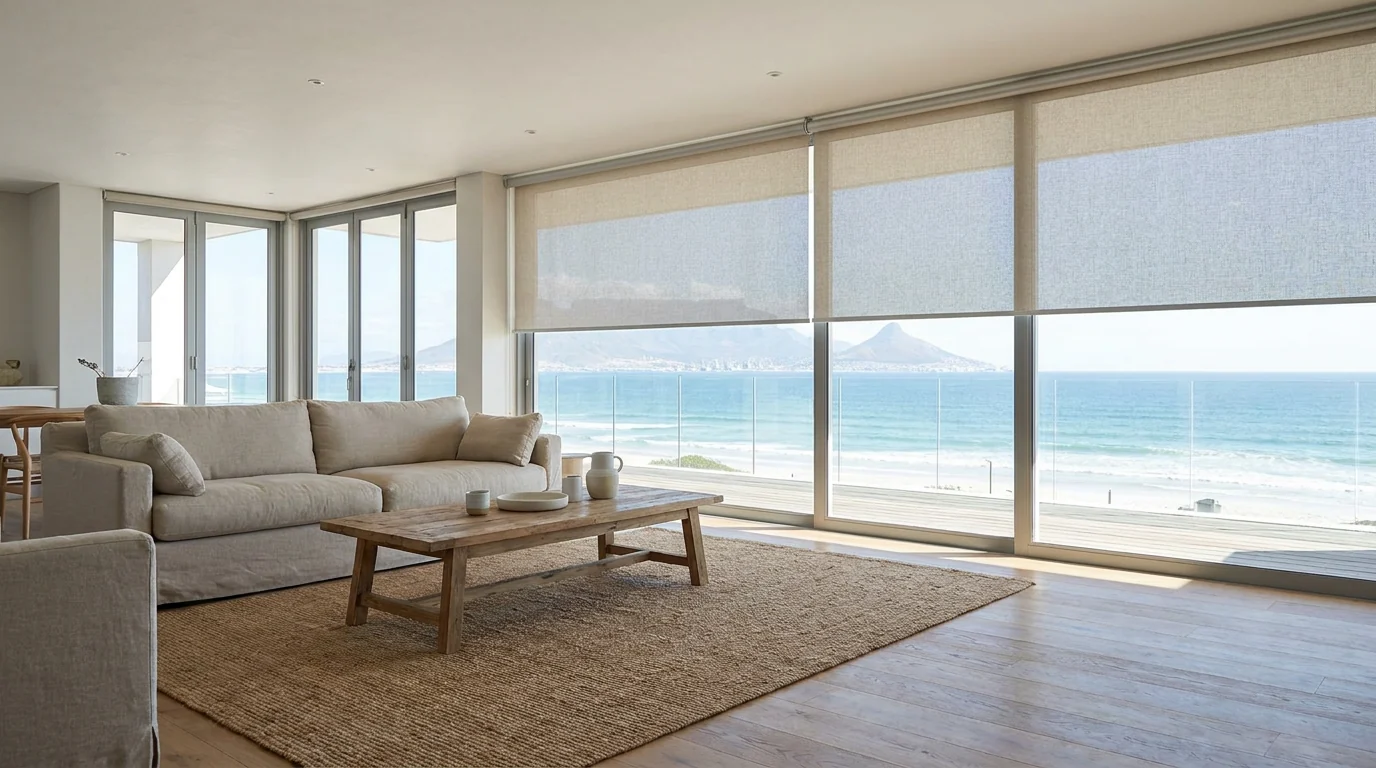
Open-plan living room in a Big Bay coastal new-build looking through floor-to-ceiling glass to Table Bay and Table Mountain, with a single smooth flat sunscreen roller blind half lowered over the glass
The Big Bay brief in one frame: a wall of glass, the bay beyond it, and a single sunscreen roller holding the light without hiding the view.
01 — The starting point

The house was built around the view. So is the shading brief.

Twenty years ago Big Bay was, in the property record's own words, "a popular surfing beach with a picnic and braai area and very little development."[3] What stands there now is one of the newest suburbs on the Western Seaboard — "a succession of secure residential estates" back into the dunes, "built in stages over the last 15 years."[3] Sandown, Blouberg Hills, Dune Ridge, Water's Edge, Kingshaven — the stock is genuinely new-build, and it is glazed to make the most of one thing: the classic view of Table Mountain across the bay.[1]

That single design instinct is why a Big Bay house needs its own shading brief rather than a generic room list. Three things follow from building around the water view, all at once, on the same glass.

  • The view and the low sun share a wall. The bay is to the west and south-west, and so is the setting sun. The picture window you bought for the sunset is the window that is unusable at five o'clock in February unless something is done at the glass.
  • The glass is bigger than a standard blind. Stacking doors, corner glazing and double-volume living walls are the Big Bay signature. Much of it runs past what a single hand-operated blind spans cleanly, which quietly makes motorisation a practical decision rather than a luxury.
  • Everything outside lives in salt and wind. These are gated estates a few hundred metres from an Atlantic beach famous for its wind. Anything mounted outside the glass has two masters — corrosion and gusts — before it has an owner.

None of that is guesswork about your house; it is what this stretch of coast has in common. What differs from stand to stand — which way the good glass actually faces, how exposed the patio is, where the power runs — is exactly what we would rather look at than assume.

02 — The light here

What the Cape sun actually does over Big Bay

Big Bay sits at roughly 33.8° south, about fifteen kilometres up the coast from central Cape Town.[1] That latitude, taken with the Earth's 23.4° tilt, fixes the sun's path for the year. At noon on the longest day the sun stands about 79° above the horizon — nearly overhead, and to the north. At noon on the shortest day it barely reaches 33°, low and due north.[1]

That winter figure matters more than it looks. Cape Town's midwinter noon sun (~33°) sits markedly lower than the Highveld's — Pretoria's is about 41°.[2] A lower sun reaches further under an eave and deeper into a room, so a north-facing Big Bay living room gets a flood of welcome winter warmth that a Johannesburg one does not. On this coast you want to be able to let winter in, not just keep summer out.

The trouble, as everywhere, is the afternoon. At midsummer the sun sets in the west-south-west, around 28° south of due west, and from about four o'clock it is low and almost horizontal.[1] An overhang cannot block a horizontal ray. West and south-west glass here — which is most of the view glass — needs something at the pane or outside it, never just above it.

Three Cape facts that change the specification

  • The wind is not a detail here — it is the headline. The prevailing summer wind is the south-easter, the "Cape Doctor," which pours off Table Mountain from October to March and can reach around 40 knots at Blouberg.[4] This is the beach that hosts the Red Bull King of the Air precisely because the wind is so dependable.[5] Anything you hang outside has to be built for it and, where exposed, retract before it.
  • Winter comes from the other direction. Cape Town's rain falls in winter, on north-west cold fronts — June is the wettest month at around 126 mm.[6] So the same west and north-west elevations that take the summer sunset also take wind-driven winter rain. Exterior hardware on those walls earns its keep in two seasons, two different ways.
  • The UV is high and the air is salt. The UV index runs very high to extreme from roughly October to April, peaking around 6 in midsummer.[6] Combined with constant salt-laden onshore air off a cold Atlantic,[1] sun-facing fabrics, slats and coatings age faster on this coast than inland. Choose a west-window fabric on performance first and colour second.
External venetian blinds mounted outside the glass on a white coastal facade, aluminium slats tilted to block low afternoon sun before it reaches the window
Stopped outside the glass. External venetian slats sit in front of the pane, so the low west-south-west sun is intercepted before it becomes heat inside the room.
03 — Room by room

Elevation by elevation, and which rooms suffer

One house, four different problems. Work out which wall a room sits on before you choose anything for it.

North — the winter friend, the summer show-off

North is where the Cape sun lives: high enough at midsummer that a modest eave shades the glass at noon, then low and pouring straight in through winter — genuinely welcome heat on a wet July day.[1] The right tool here adjusts: an aluminium venetian bounces high summer light off the ceiling and opens flat to take the winter sun, or a sunscreen roller softens glare without killing the warmth.

Verdict: adjustable beats absolute — don't black out your best winter room.
West & south-west — the view wall that costs you the room

This is the Big Bay elevation: the bay view and the setting sun on the same glass, taking a low, near-horizontal blast from four o'clock at midsummer.[1] If the room is unbearable at five, the pane itself is heating and radiating inward — an interior blind fixes the glare instantly but the heat only partly, because the energy is already inside.

Verdict: stop it outside the glass if you can; a low-openness sunscreen if you can't.
East — glare first, heat second

The mirror image, into a house that cooled overnight. Bedrooms on this wall get woken early from spring onward; a kitchen takes an hour of hard morning glare and is then done for the day. The answers differ within one wall — proper darkness where people sleep, something you can still see through where you work.

Verdict: solve for sleep and glare, not for heat.
South — even light, and the wind-and-privacy wall

Almost no direct sun for most of the year, so these rooms hold the steadiest light in the house. On a Big Bay stand the south side is often the one facing a neighbour a few metres away, and it takes the south-easter square-on. Shading is rarely the issue here; privacy, draughts and cold glass usually are.

Verdict: think privacy and warmth, not sun.
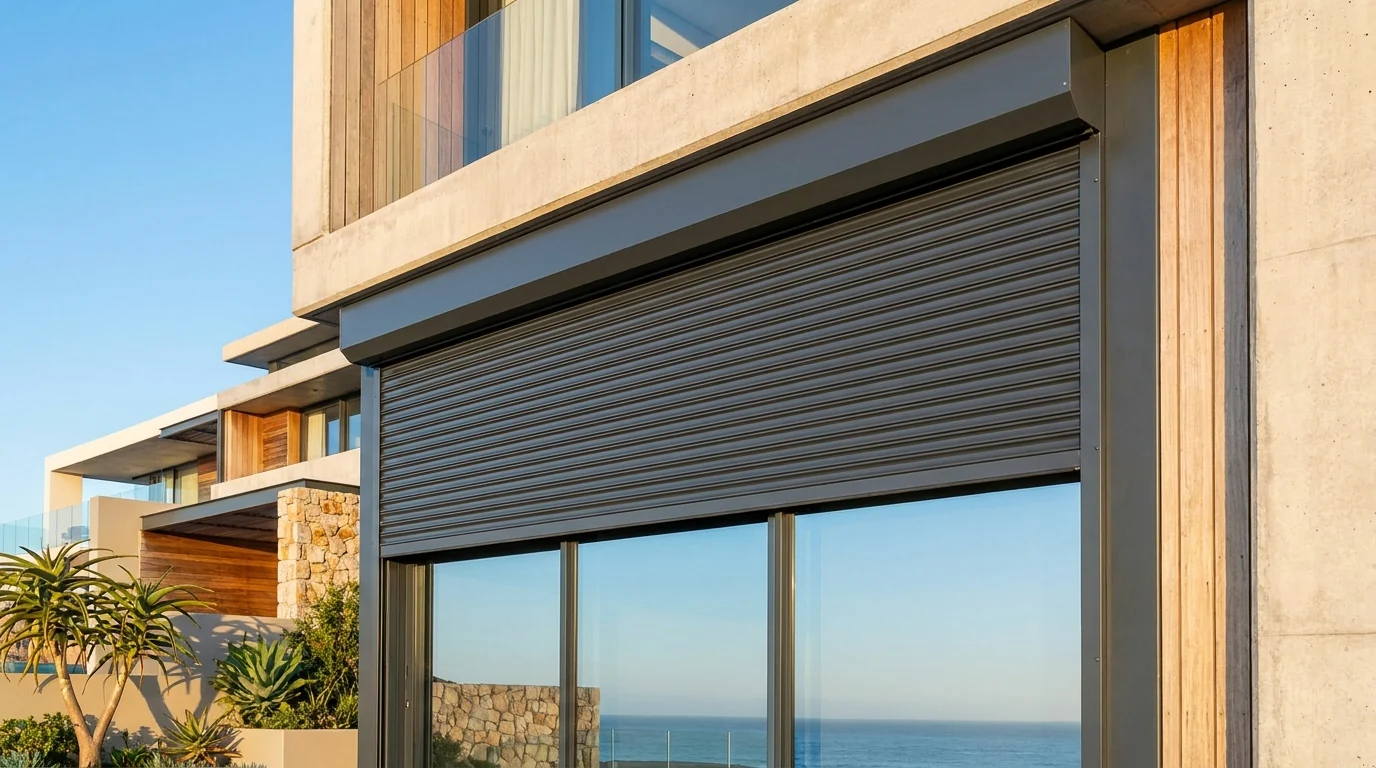
An exterior aluminium roller shutter partly rolled down over a large window on a Big Bay coastal home, its rigid horizontal slats descending from a headbox in slim side guides on the outside of the glass, stopping low afternoon sun before it reaches the pane
The hard-west option. An external roller shutter stops the heat and glare outside the glass altogether and gives full darkness when down — shading, not security. The trade-offs are in section 04.
Optional

Want this marked up for your own house?

Tell us which rooms are giving you trouble and we'll send this same guide back with your elevations noted against it — which windows we'd treat first, and what we'd be weighing up on each.

It's an email, not a visit. Nobody phones you about it.

Used only to send you this guide and, if you ask for it, to arrange your free in-home measure (POPIA). We don't share your details, sell them, or add you to a marketing list.

04 — The specification

What we'd fit here, and the catch with each

Every one of these is right somewhere in Big Bay and wrong somewhere else. Tap "add to my list" as you read and it carries straight into the ballpark and the measure form below — nothing to retype.

Sunscreen roller blinds

West · the view glass

One flat sheet of open-weave fabric on a tube — no folds, no pleats. In a low openness (3–5%) it knocks the glare off the water and a useful share of the heat while keeping the bay and the mountain visible through the weave, which on a Big Bay view wall is the entire point.

The trade-off

It reverses after dark: lights on inside and the room is on display from the beach path — a real issue on a close estate stand. There we'd pair it with a blockout on the same opening rather than pretend one fabric does both jobs.

Blockout roller blinds

Bedrooms · east & street side

A single smooth flat sheet, no folds at all, sitting neatly in the reveal. Against an early Cape sunrise on an east bedroom, or a streetlight-lit estate road, it is the most effective thing there is — and a genuine thermal layer on a cold, wet winter night.

The trade-off

Binary — down is dark, up is everything — so the wrong tool for a north living room where you want the winter sun. Without side channels, a little light always finds the edge of the reveal.

Double roller (day & night)

View bedrooms · living rooms

Sunscreen and blockout on one bracket, so you run the open weave for the daytime view and drop the blockout for privacy and darkness at night. On a Big Bay bedroom that still wants the bay, this is often the honest answer instead of choosing once.

The trade-off

Two fabrics and one more bracket means a little more cost and a little more to service over ten years than a single roller. Worth it on a view window; overkill on a scullery.

Aluminium venetian blinds

North · kitchens · bathrooms

Powder-coated metal slats that tilt to steer light rather than block it — high summer sun onto the ceiling, flat for the winter warmth — and shrug off steam, splashes and the salt air that eats cheaper finishes. The practical adjustable pick for the working end of a coastal house.

The trade-off

A long slat stack can rattle in a through-draught, which on a windy coast is worth thinking about near an opening window. Cooler and more utilitarian in feel than timber in a formal room.

Cellular / honeycomb blinds

South · cold & west rooms

Air trapped in a honeycomb weave held against the glass — the cheapest thermal upgrade you can make to a window without touching the window. Against a cold, damp Cape winter and the draught off a south wall, it takes a real edge off both.

The trade-off

A soft product, so not for a busy kitchen — and it slows heat, it doesn't reject a hot west sun the way exterior shading does. The gain sits on the winter side of the ledger.

External venetians

Hard west & north-west glass

Tiltable aluminium slats mounted outside the pane, so they intercept the low afternoon sun before it becomes heat inside — while still steering daylight rather than blacking the room out. On a hard west Big Bay wall this beats an interior blockout roller: stopping the heat outside the glass keeps the room cooler than absorbing it in.

The trade-off

It lives outside in salt and a 40-knot southeaster,[4] so it needs wind-rated hardware, a marine-grade finish and — where exposed — a wind sensor. And because it changes the facade, an estate may want to approve it first.

Roller shutters (shading)

West bedrooms · exposed glass

Rigid aluminium slats rolling down the outside of the window from a headbox above it. On a hard west elevation we'd put these ahead of an interior blockout: they stop the heat and the glare outside the glass, give total darkness when fully down, and shrug off wind-driven rain on a winter front.

Shading, not security. Ours are made for sun, heat, glare and light control on the outside of the glass. They are not security-rated shutters — a different product, which we can quote on request.

The trade-off

The most visible change you can make to a facade, and the headbox has to live somewhere — on an estate stand that is a permission question before a measurement. Marine-grade coating is non-negotiable this close to the sea.

Zip screens & outdoor blinds

The patio · the wind side

Mesh tensioned inside zipped side channels so the wind cannot lift it, dropping vertically to seal a patio. On a coast where the southeaster decides whether you can sit outside, the zipped channel is the whole difference between a screen that holds and one that flaps and tears.

The trade-off

It encloses the view on that side while it's down, and mesh openness is a genuine decision — more openness keeps more view and stops less wind and glare, and no single setting does both.

Motorisation & automation

Wide glass · all exterior products

Quiet tube motors on remote, switch or timer for a wall of glass no chain can operate comfortably — and, on anything outside, a wind sensor that retracts it whether you're home or not. On this coast that sensor is protection, not a gadget: it's what keeps an awning or screen attached the morning after a proper southeaster.

The trade-off

It adds cost per blind and needs power at the head of the opening — in a finished house, a cable route somebody has to find. Battery motors avoid the chasing but need charging now and again.

Also on the list in the form below: vertical blinds for very wide sliders and stacking doors, skylight & shaped blinds made to the pitch of a gable or a stairwell window, and concealed blind boxes, where the fabric drops from a slot in the ceiling and every bracket disappears — that last one is best planned at build or renovation stage, so raise it while you still have plans on the table.

A single smooth flat sunscreen roller blind two-thirds down over a west-facing living-room window in a Cape Town coastal home, cutting low afternoon glare while the sea view stays visible through the open weave
Glare down, view kept. A low-openness sunscreen roller on the view wall: the glare and UV drop, the bay stays visible through the weave. After dark, pair it with a blockout.
05 — The local constraint

Salt, wind, and who else gets a say

Two forces decide what survives outside the glass on this coast, and a third decides what you're allowed to put there.

Salt. Constant onshore air off a cold Atlantic carries salt that corrodes unprotected steel and cut-price brackets fast.[1] On anything exposed we fit powder-coated aluminium, sealed cassettes and stainless or coated fixings as standard — and we'll say plainly at the measure that even marine-grade hardware appreciates an occasional fresh-water rinse this close to the water. That's honesty, not a disclaimer.

Wind. The southeaster is the defining fact of Big Bay, strong from October to March and gusting toward 40 knots.[4] Exterior products get wind-rated hardware and, where exposed, a motor with a wind sensor that retracts them automatically. That is the difference between shading that lasts and shading you replace after the first big blow.

The trustees and the architect. Big Bay is largely gated estates,[3] and that almost always means an architectural review controlling the outside of the building. Interior blinds inside a reveal change nothing outside and are rarely a permission question. Exterior products — external venetians, roller shutters, awning and zip-screen boxes — do change the facade, so on an estate stand you establish approval first. We fit blinds; we are not your trustees. At the measure we'll flag which options touch the outside of the building and hand you the specification sheet to submit. It adds a week or two. It does not add drama.

Renovating or still on plan? South Africa's energy standard, SANS 10400-XA:2021, requires a fenestration calculation once glazing passes 20% of floor area — and designing a concealed blind box in at build stage costs far less than retrofitting one, so raise it early.

A Big Bay coastal patio enclosed by an exterior zip screen, the tensioned mesh held tight in zipped side channels against the sea wind while a soft view to the beach stays visible through it
Held, not flapping. Zipped side channels are what let an outdoor screen survive a Big Bay southeaster — the mesh can't lift out of the track.
06 — The honest limit of a guide

What we'd still need to check on site

Everything above is what we know about Big Bay. What no guide can know is your house — and five things decide the actual specification.

01

Reveal depth, and whether the opening is square

Depth decides whether a blind can sit inside the opening at all, and which bracket is used. Openings are rarely perfectly square either — 10 mm out top to bottom is ordinary and changes how the blind is made.

02

The real wind exposure at that opening

A sheltered courtyard between two wings and an open western corner facing the beach need different products, projections and sensors. It's obvious in two minutes standing there and impossible to read off a floor plan.

03

Which way it really faces, and what's outside it

We take a compass reading at the window — twenty degrees moves the recommendation between west and south-west. Then we look out of it: a neighbour's wall, a dune or an open beach each change the privacy and glare answer.

04

What the wall is actually made of, and where the power is

Plaster over brick, over block, or a drywall bulkhead from a later fit-out — the substrate decides what can safely hang there. For anything motorised, the route from a plug to the head of the opening is a walk-around with a torch, not a guess over the phone.

05

Your estate's architectural rules

Before we quote anything exterior on an estate stand, we confirm what the review committee allows — headbox colour, projection, whether it's permitted at all. Better to know at the measure than after the order.

07 — Two ways forward

Book the free expert measure

A consultant comes to the house with samples, measures every opening properly, reads the light and the wind in the actual room, and leaves you with a written quote itemised per window. It costs nothing and commits you to nothing. Would you rather have a rough number first? The ballpark list sits inside the form below and does exactly that.

  • A free in-home measure and a written quote, itemised per window
  • No call centre — a real consultant comes out with samples
  • Marine-grade hardware and child-safe controls as standard, not extras
  • Nothing is made until you've approved the quote
  • Still deciding? Say so on the form and we'll leave you be

Our consultant does five to six measures a week across Big Bay and the Blouberg coast, so the diary tends to fill early in the week. Tell us which days suit you and we'll work around them.

Anything you added while reading is already ticked on the form — you don't have to type it in again.

What are you interested in? (tick any)
Want a ballpark figure first? Open this — about two minutes.

Big Bay Blinds — window list

Walk the house, fill this in by hand, then type it into the form on bigbayblinds.co.za when you get back. Measure the width first, then the drop, in millimetres.

Pop in rough sizes and we'll send a budget range by the next working day. Not sure how to measure? Leave it blank — our consultant measures for free and you'll get exact per-window pricing either way. This part is entirely optional and nothing in it is binding.

Room Width (mm) Drop (mm) Inside or outside the reveal Product Remove

Nothing on the list yet — and it stays entirely optional.

Whatever you enter here travels with your enquiry as plain text. No uploads, no third-party services, nothing stored anywhere else. If photographs would help, a consultant will simply ask you for them in the reply.

By sending this you consent to us using these details to arrange your free in-home measure and consultation call-back only (POPIA). We don't share your details, sell them, or add you to a marketing list. If you tell us you're still researching, we won't call you.

Neither, for now

Just take the guide, marked up

Not ready for a visit or a number? Tell us which rooms are the problem and we'll email this guide back with your own elevations noted against it. Nothing is booked and nobody phones.

Used only to send you this guide (POPIA). Never shared with anyone else.

Working out

Sources

Every climate, geography, planning and solar claim above traces to one of these. Where we've reasoned or calculated rather than cited, we've said so here.

  1. Bloubergstrand & Big Bay, Wikipedia — coordinates 33.7972°S, 18.4620°E; ~15 km north of central Cape Town; "classic view of Table Mountain across the bay"; cold Benguela-current water and world-class kite/wind-surf conditions. The solstice sun altitudes (~79° summer noon, ~33° winter noon) and the west-south-west summer sunset are calculated from this latitude and the Earth's 23.4° axial tilt — standard geometry, not a Cape-specific published table. en.wikipedia.org/wiki/Bloubergstrand
  2. "Sun, shade and natural daylight in South African town planning, with emphasis on Pretoria," SciELO SA — winter-solstice noon altitude 40.84° at Pretoria (26°S), used here only as the inland comparison that shows how much lower Cape Town's winter sun sits. scielo.org.za — S2415-04952018000200005
  3. Seeff Property Group — Big Bay area profile: "very little development" twenty years ago; "a succession of secure residential estates … built in stages over the last 15 years"; the estate names; Table Mountain and Robben Island views; venue of the Red Bull King of the Air. seeff.com — Big Bay area profile
  4. Cape Town / Blouberg wind — the predominant south-to-south-east "Cape Doctor," strong in the October–March windy season and reaching around 40 knots at Blouberg. ikointl.com — kitesurfing South Africa · windfinder.com — Big Bay
  5. Big Bay as the annual venue of the international Red Bull King of the Air kitesurfing competition, with the wind described as the beaches' "life-blood." seeff.com — Big Bay area profile
  6. Cape Town Mediterranean climate & UV — hot dry summers, mild wet winters; June the wettest month (~126 mm), February the driest (~19 mm); UV index very high to extreme October–April, peaking around 6 in midsummer. weather-atlas.com — Cape Town climate · weather-and-climate.com — Cape Town

Three honest caveats. The sun angles are calculated from Big Bay's latitude and are accurate to well under a degree, but we quote them as geometry rather than as a measured local reading. We found no published architectural-guideline document for any specific Big Bay estate, so section 05 is a general "check yours" rule, never a claim about your scheme. And the salt-corrosion point is drawn from the marine environment and standard coastal practice — it is a reason to specify marine-grade hardware, not a cited laboratory rate.

Ready when you are

Now let's go and look at your actual windows.

Free in-home measure, samples in hand, and a written quote itemised per window. One of our expert consultants will contact you shortly to arrange it — no obligation, no pressure.